DLSS 5 Is Here — 3D-Guided Neural Rendering Debuts in NBA 2K27
A new AI rendering stage aims to close the gap between real-time games and Hollywood-grade photorealism, running on every GeForce RTX 50 Series GPU starting September 3.
DLSS 5 goes live September 3 at 9 p.m. Pacific, launching first in NBA 2K27 on every GeForce RTX 50 Series GPU, desktop and laptop, plus GeForce NOW. NVIDIA is calling it the biggest graphics breakthrough since real-time ray tracing in 2018: a new AI rendering pass, 3D-Guided Neural Rendering, that adds lighting and material detail real-time rendering has never been able to produce on its own. It's also been the most argued-about DLSS release yet. Since the March reveal, critics have said the technology's treatment of human faces can look artificial — something Jensen Huang has dismissed outright, calling detractors "completely wrong."
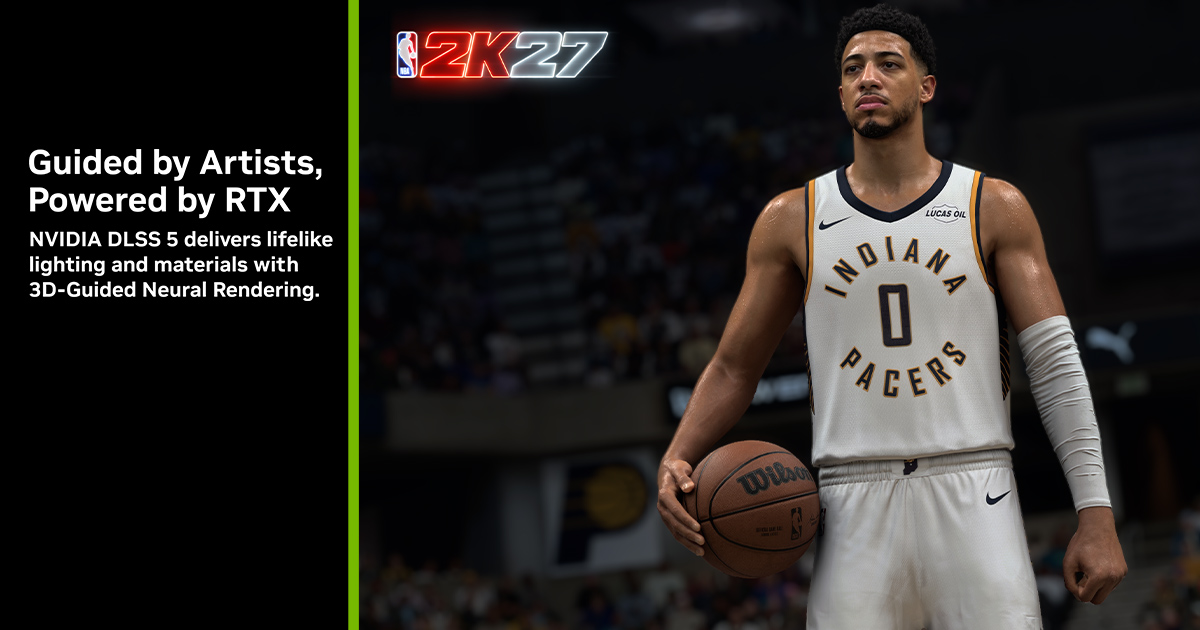
Image via NVIDIA
NVIDIA frames this as the next step in a 25-year chase: programmable shaders on the GeForce 3 in 2001, CUDA on the 8800 GTX in 2006, real-time ray tracing on the RTX 2080 Ti in 2018, path tracing and neural shaders on the RTX 5090 in 2025. Roughly 375,000x more compute along the way, by NVIDIA's count — and it still isn't enough to brute-force photorealism at 60-plus frames a second.
A Hollywood VFX frame can take hours to render offline. A game frame gets about 16 milliseconds. That budget forces compromises — hair becomes simplified geometry, skin loses the layered depth it has in reality. NVIDIA's bet is that a trained model can approximate how light moves through skin or hair for a fraction of the cost of actually simulating it, which is the whole premise behind DLSS 5.
DLSS has always used AI for performance — Super Resolution upscaling since 2018, then Frame Generation and Multi Frame Generation. DLSS 4.5 already draws 23 of every 24 pixels you see. DLSS 5 doesn't touch any of that. It adds a different job entirely: fixing image quality, not frame rate.
Regular generative AI models are a bad fit for games — prompt a diffusion model with the same text ten times and you get ten different images, which is fine for concept art and useless for a character's face that has to stay the same from frame to frame. So DLSS 5 skips the text prompt entirely. It takes the engine's own rendered frame — the artist's geometry, textures, motion vectors, lighting — as a fixed starting point, then adds lighting and material detail on top. The engine decides what has to stay the same; the artist decides what the model is allowed to touch.
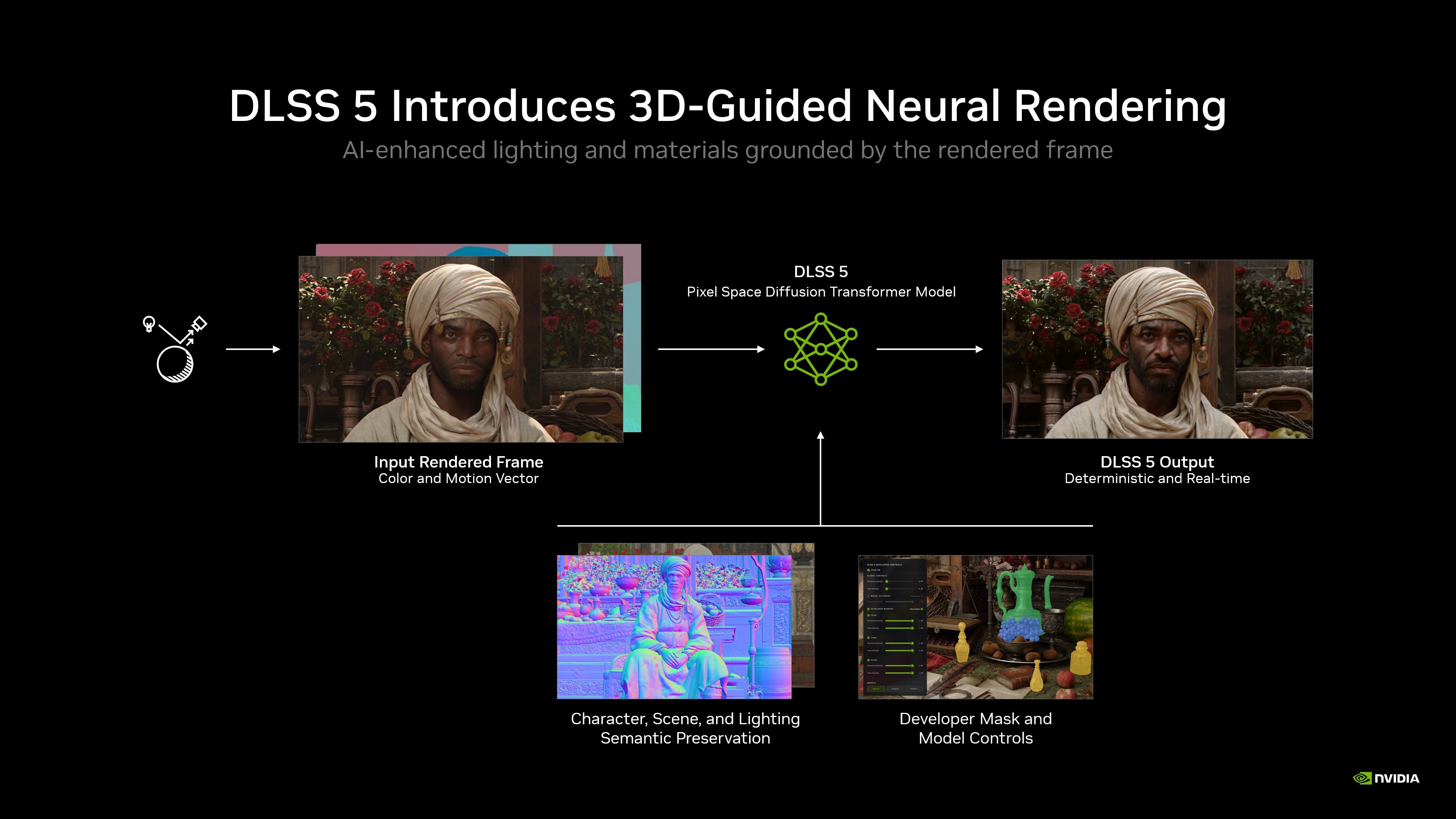
Color and motion vectors go in; deterministic, temporally stable lighting and materials come out, anchored to the game's own content. Image via NVIDIA
Building this meant solving three things generative AI is normally bad at in games. Determinism first: identical input has to produce identical output, so the model stays grounded in the artist's original scene instead of improvising. Then temporal stability — unlike video models that work on batches of frames, DLSS 5 runs strictly one frame in, one frame out, using the engine's own motion vectors to stay stable as the camera moves, rather than shimmering or swimming the way looser AI video techniques tend to. And speed: the model has to finish in milliseconds on one GPU, which is where the FP4 Tensor Cores unique to Blackwell earn their keep.
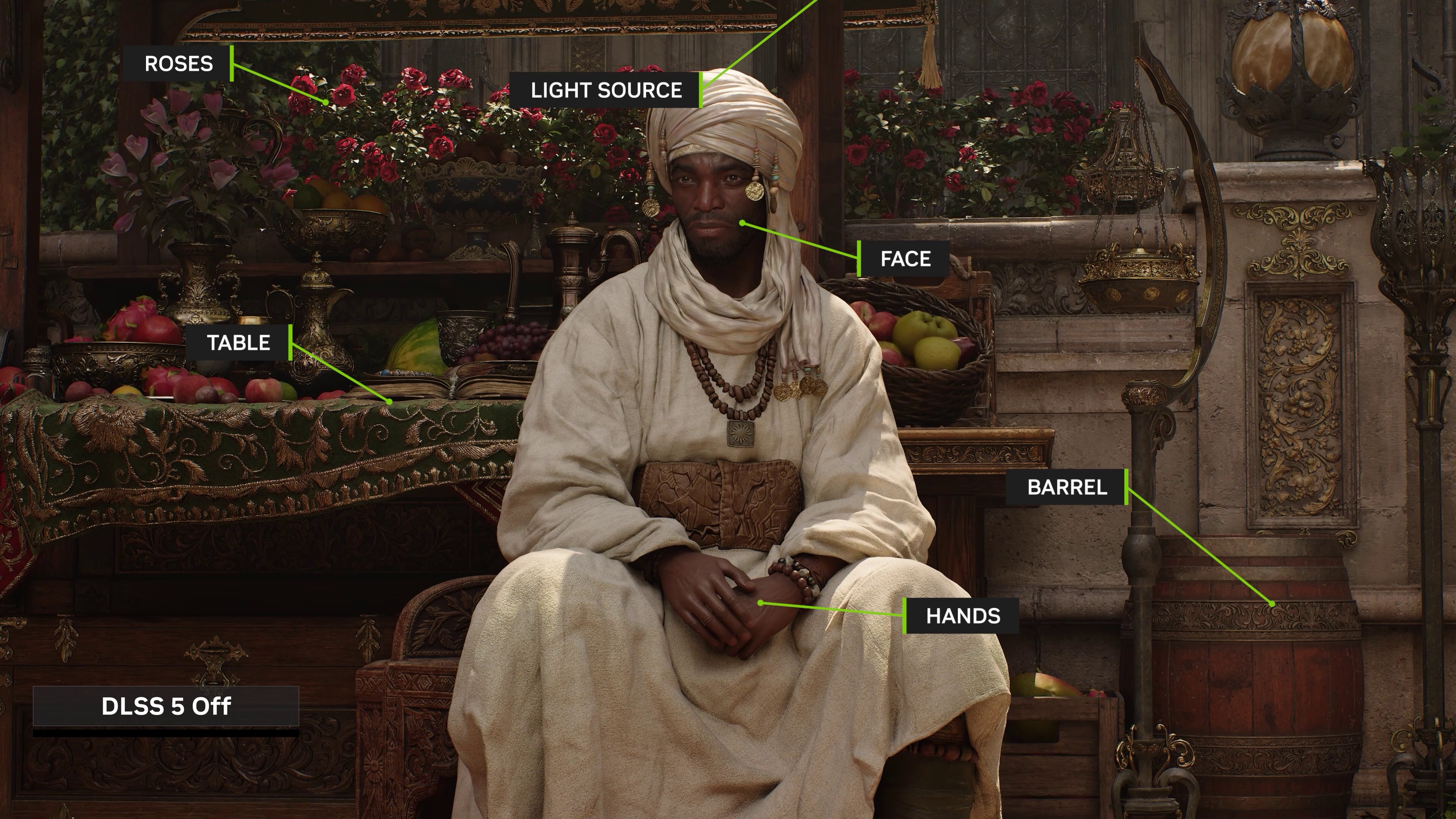
The model identifies objects, materials, and light sources before deciding what to enhance. Image via NVIDIA
Edward Liu, NVIDIA's Director of Applied Deep Learning Research, and Gabriele Leone, Director of Content Technology, on how the artistic controls work. Video via NVIDIA's official YouTube channel
For players it's an on/off toggle, nothing more. For studios, NVIDIA built out a real set of art-direction tools — "more realistic" is a creative call, and it stays with the studio. The DLSS 5 SDK offers several trained models with different characters, and a team can mix them per scene: one for dense outdoor foliage, a different one for a moody indoor cutscene.
Two sliders do the fine work. Structure Intensity covers high-frequency detail — ambient occlusion, contact shadows, subsurface scattering. Tone Intensity covers the low-frequency stuff, broad lighting and color; set it to zero and you keep the rendered frame's exact original colors, or push it up for a stronger grade. Semantic masking automatically picks out objects in a scene, so a studio can push environmental detail while holding back on faces, or the reverse. Engine-level masking goes further, isolating specific props — glass, water, foliage — for their own treatment without touching anything else.
Because the model is anchored to whatever the engine actually renders, better input still means a better result — DLSS 5 improves plain rasterized graphics, but feeding it ray-traced or path-traced lighting produces a much bigger jump. It amplifies what's already there. It doesn't fix bad underlying rendering.

Global and per-object controls over the final frame. Image via NVIDIA
Visual Concepts and 2K's NBA 2K27 is the launch title, available now for RTX 50 Series PCs and laptops, and on GeForce NOW Ultimate streaming from RTX 5080-class hardware in the cloud. "DLSS 3D-guided neural rendering helped boost the visual quality of our materials and lighting, bringing a real jump to photorealism across the game," said Peter Kavic, Senior Producer at Visual Concepts. He described the controls as letting the studio "set the overall tone and style to match our existing art direction and then really get precise where it matters most, using a per pixel uplift control mask to fine tune detail on characters" — important, he noted, given the need to respect real athletes' likenesses.
With it turned on, Cade Cunningham and Tyrese Haliburton get more convincing subsurface scattering under arena lighting, tighter contact shadows around jersey collars and compression sleeves, and more natural light through their hair. Courtside spectators and staff get the same lighting and material treatment, all without the facial geometry itself — scanned from the real athletes — changing at all.
Video via NVIDIA's official YouTube channel

Cade Cunningham with DLSS 5 enabled — skin subsurface scattering, hair light transmission. Image via NVIDIA
Here's the part that actually matters for buying a GPU: DLSS 5, stacked with Super Resolution and Multi Frame Generation, still runs fast. NVIDIA's own numbers for NBA 2K27 at Ultra Preset with ray tracing on:
| GPU | 4K (3840×2160) | 1440p (2560×1440) | 1080p (1920×1080) |
|---|---|---|---|
| GeForce RTX 5090 | 370 FPS | 590 FPS | Uncapped / very high |
| GeForce RTX 5080 | — | 410 FPS | Uncapped / very high |
| GeForce RTX 5070 Ti | — | 350 FPS | Uncapped / very high |
| GeForce RTX 5070 | — | 260 FPS | Uncapped / very high |
NVIDIA's own first-party benchmarks for NBA 2K27, Ultra Preset, ray tracing on, full DLSS 4.5 + DLSS 5 stack. Not independently verified by HardwareFPS. At 1080p, NVIDIA says virtually every RTX 50 Series card handles ray tracing, Ultra Preset, and DLSS 5 together without issue.
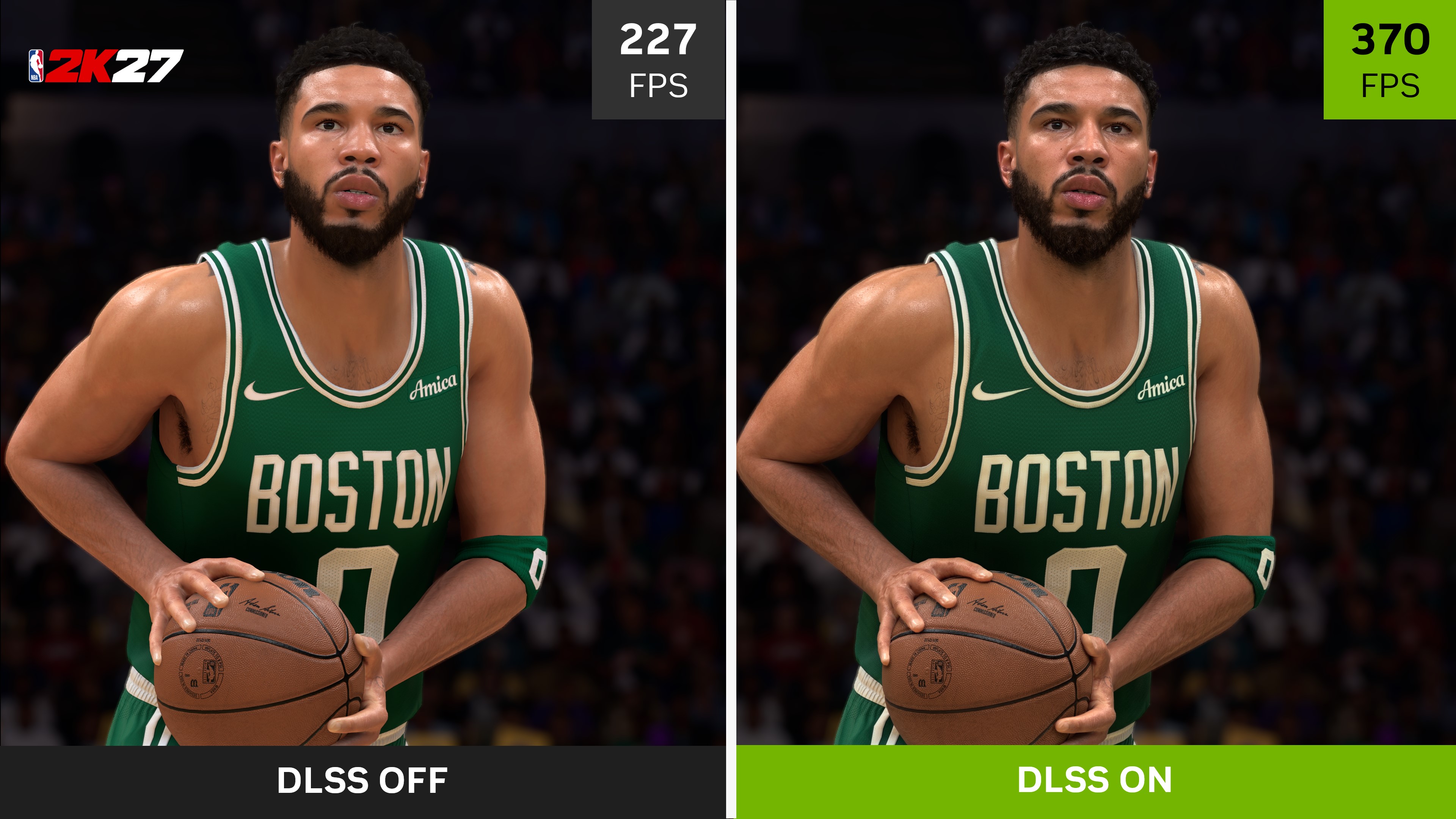
370 FPS at 4K Ultra with ray tracing on, RTX 5090, full DLSS stack. Image via NVIDIA
The March GTC demo needed two RTX 5090s running together. Six months later, the same workload fits on a single card — roughly a 5x jump, which NVIDIA credits to ordinary pipeline optimization and model refinement rather than any one breakthrough. NVIDIA says the curve hasn't flattened out, and is promising further model updates this fall.
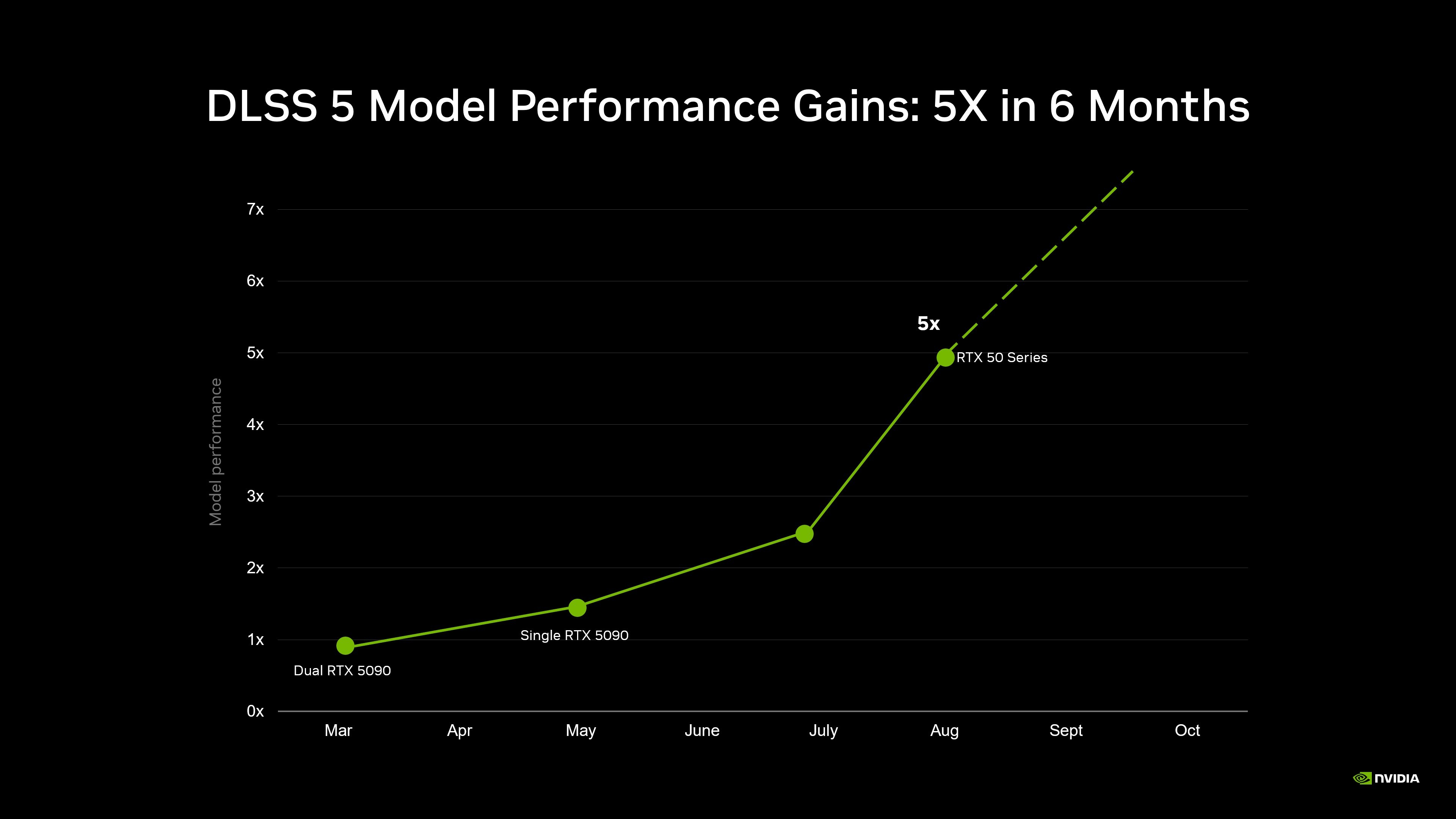
Six months of optimization took DLSS 5 from two RTX 5090s to one card. Image via NVIDIA
The pushback started with the March demo, which showed the tech applied to Resident Evil Requiem's character Grace, among other scenes. A vocal chunk of the community has called the result "AI slop" — faces that look artificial, an effect that can override a developer's original artistic intent rather than support it. Jensen Huang isn't having it, calling critics "completely wrong" and pointing back to the extensive developer controls as proof studios can dial the effect to their own taste rather than get stuck with one look. NVIDIA's own materials keep circling back to the same point: for players it's a toggle, but the actual result in any given game is a call the developer made, not NVIDIA.
Past NBA 2K27, NVIDIA has a long list of publishers building DLSS 5 support: Bethesda, CAPCOM, Hotta Studio, NetEase, NCSOFT, S-GAME, Tencent, Ubisoft, Warner Bros. Games. "With DLSS 5, the artistic style and detail shine through without being held back by the traditional limits of real-time rendering," said Bethesda's Todd Howard, confirming the tech is coming to Starfield and future titles. CAPCOM's Jun Takeuchi called it "another important step in pushing visual fidelity forward" for Resident Evil. Vantage Studios co-CEO Charlie Guillemot said it's "letting us build the kind of worlds we've always wanted to" on Assassin's Creed Shadows.
Also confirmed: AION 2, Black State, CINDER CITY, Delta Force, Hogwarts Legacy, Justice, NARAKA: BLADEPOINT, NTE: Neverness to Everness, Phantom Blade Zero, Sea of Remnants, The Elder Scrolls IV: Oblivion Remastered, and Where Winds Meet. NVIDIA says more titles are coming in the next few months.
Grab the September 3 Game Ready Driver from the NVIDIA app or GeForce.com, then in NBA 2K27 go to Video Settings and flip on "DLSS Neural Rendering." Super Resolution, Frame Generation, and Reflex settings work independently of it, and you can toggle it mid-game or during instant replays with F9.